36 years of hands-on hardwood craftsmanship: why an owner-operated flooring company saves you money and heartache
When you ask Mario Ciaparrone what defines Hardwood Floors by Mario after more than three and a half decades on his knees in Western Washington homes, he does not talk about showroom square footage or sales quotas:
“Hardwood Floors by Mario is a 36-year-old company owned and operated by Mario personally. With my experience I am able to deliver quality and economic jobs to fit my customers. Every job is unique in style and character that creates an environment to soothe your inner being. We don’t only deliver material, but also creativity and peace of mind.”
Think of a hardwood floor like an acoustic guitar. In the hands of a master luthier who reads the grain, checks the humidity, and shapes every joint himself, the wood settles into harmony with the home for fifty years. On a rushed assembly line, the same timber warps, cracks, and fights its surroundings within two seasons.
Here is why hiring a 36-year owner-operator who bids your project and works on your floor personally is often the most economical decision you can make.
Behavioral proof: why retail subcontractor networks rarely stop a bad job
When a homeowner buys flooring installation through a national big-box store or a high-volume retail showroom, the company on the receipt rarely employs the people who show up at the front door. Instead, the retailer acts as a sales broker: it marks up the labor fee and assigns the job to a rotating third-party subcontractor crew paid by the square foot.
As independent industry analyses of big-box vs. owner-operated flooring installations document, that piece-rate structure creates three hidden pressures that cost homeowners dearly:
- The $1,000-a-day stoppage penalty: If a subcontracted crew arrives at your house, opens the boxes, and realizes the subfloor is too damp or the product batch is wrong for the room, stopping the job costs that crew roughly $1,000 a day in lost piece-work income. Because they cannot afford an unpaid day off, the overwhelming financial pressure is to lay the floor anyway and move on to the next address.
- Skipped subfloor leveling and surprise change orders: Retail promotional quotes are engineered to look low on a shelf tag by excluding the time-consuming preparation underneath. Once the old carpet comes up, piece-rate crews either rush past minor dips—leading to hollow spots, squeaks, and separating joints—or present day-of-install upcharges while your furniture is sitting in the garage.
- The triangle of blame: When boards cup, gap, or peel after the first rainy Puget Sound winter, the homeowner calls the retail store’s 1-800 customer service line. The retailer blames the installation crew; the subcontractor blames the product manufacturer or house humidity; and if a repair crew is eventually dispatched, it is almost never the crew that installed the floor.
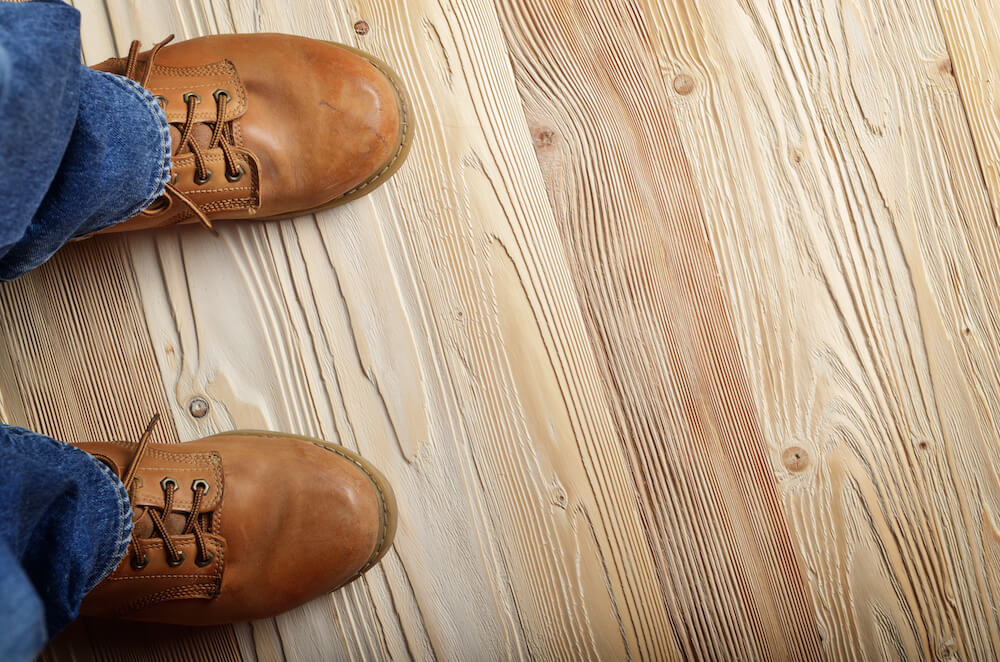
With an owner-operated craftsman, that triangle does not exist. The person who shook your hand at the estimate is the person standing on your subfloor in work boots—and the person whose name and phone number stand behind the finished room.
The physics of Western Washington subfloors: what 36 years teaches you to measure
Wood never stops breathing. It absorbs and releases moisture until it reaches Equilibrium Moisture Content (EMC) with the air and subfloor around it. In Thurston County and Pierce County—where vented crawl spaces, coastal marine air, and winter heating cycles create sharp seasonal humidity swings—ignoring moisture physics is the number-one cause of ruined hardwood floors.
According to National Wood Flooring Association (NWFA) moisture-testing protocols published in Hardwood Floors Magazine, a professional hardwood installation requires disciplined verification before a single board is fastened:
- 20 subfloor readings per 1,000 square feet: Testing across exterior walls, plumbing runs, and crawl-space spans to verify that a wood subfloor sits at a dry baseline (typically 12 percent moisture content or less) with no hidden leaks.
- 40 board readings per 1,000 square feet: Scanning delivered hardwood planks to confirm they have acclimated to the home’s normal living conditions (60°F to 80°F and 30% to 50% relative humidity, maintained for at least five days prior).
- The 2-percent rule for wide planks: Under NWFA standards, solid strip flooring (under 3 inches wide) must be within 4 percent moisture content of the wood subfloor before installation—and wide-plank flooring (3 inches or wider) must be within 2 percent.
Experience matters just as much during wood floor repair and restoration. When a refrigerator line leaks or a damp crawl space causes boards to cup (where the edges of each plank curl higher than the center), an inexperienced operator will run a drum sander across the floor immediately to flatten the high edges. Months later, when the core of the wood finally dries out and shrinks back down, those sanded edges drop below the center of the plank—creating permanent convex ridges known as crowning that ruin the floor. A 36-year veteran knows to verify moisture readings at multiple depths before touching a cupped board with sandpaper.
How 36 years of experience makes your project more economical
Many homeowners assume that a seasoned craftsman must cost more than a volume contractor. In practice, deep experience lowers your total cost by prescribing the minimum effective intervention instead of the biggest sales ticket:
- Surgical board lacing instead of full-room tear-outs: A commissioned retail salesperson has one solution for a water-stained kitchen doorway or pet-damaged corner: tear out the entire floor and buy new boxes. Mario regularly performs targeted repair and restoration—removing only the damaged Douglas fir or oak planks, lacing new boards into the existing pattern, and blending the finish so you keep 85 to 90 percent of your original floor.
- Saving your floor with a 1-day recoat: When a floor’s finish is dull but not worn through to bare wood, Mario can recommend a 1-day screen and recoat at roughly half the cost of a full sanding—preserving your wear layer for the future.
- Matching the right material to the budget: Whether your home calls for custom solid or engineered hardwood installation, restoring 1920s Tacoma fir, or laying durable vinyl plank in a high-moisture basement or rental, an owner-operator without corporate overhead tailors the scope to your budget.
| Project Stage | 36-Year Owner-Operator (Hardwood Floors by Mario) | Big-Box / Retail Subcontractor Model |
|---|---|---|
| Initial assessment & quote | Mario personally inspects your floor, wear layer, and subfloor conditions; recommends repair, recoat, refinish, or install | In-store salesperson or estimator sells from a product catalog; often incentivized to sell full replacement |
| Subfloor & moisture testing | Direct evaluation of subfloor flatness, crawl-space moisture, and NWFA acclimation tolerances before work starts | Piece-rate crews face ~$1,000/day lost income if they delay a job for moisture or subfloor prep |
| Salvaging existing hardwood | Skilled at lacing in replacement boards, blending stains, and preserving historic oak, maple, and Douglas fir | Rarely offers surgical board repair or custom stain matching on existing floors |
| Who performs the work | Owned and operated by Mario personally with over 36 years of hands-on craft | Rotating third-party subcontractor crew assigned through a vendor dispatch system |
| Long-term accountability | One direct local phone number—(253) 732-6462—serving 14 Thurston & Pierce County communities | Corporate call center routing between retailer, broker, and subcontractor |
Start with a conversation, not a sales pitch
Based in Yelm, Mario serves homeowners across Thurston County (Yelm, Lacey, Olympia, and Tumwater) and Pierce County (Tacoma, Puyallup, Gig Harbor, Lakewood, University Place, Fircrest, DuPont, Spanaway, Frederickson, and Parkland).
If you want an honest assessment from the craftsman who will actually care for your floor, call Mario at (253) 732-6462 or request an estimate.